Published work
Fire safety is a critical skillset that transcends professional boundaries. From industrial settings to educational institutions, knowing how to handle a fire can make all the difference. Initially, the project was all about training people on conventional practices in dangerous situations involving fires.
The fire project was launched with the intention of educating the students in the Federal Center of Technology in the complex field of fire detection and classification. To understand how best to combat fires, students were trained in classifying them into categories like Class A, B, and C, among others. The project did not merely stop at fire classification; it also provided training in first aid and emergency response, aiming to create a holistic safety education program. The project was deemed significant within the institution, offering certification and featuring large-scale lectures.
The project took a turn in 2020, led by a fortuitous interaction with Maryêva, a student involved in the initial training sessions. Inspired by the training and using my tech background, I approached the project coordinator, Professor Myrna, culminating in an expansion of the project: To create an artificial intelligence capable of detecting fires.
The suggestion was to develop an AI model trained on a fire database, which would then be capable of automatically detecting fires. This idea was particularly enticing given that I already had some expertise in AI and user interface development. This is mainly because of my experience in launching a startup, Pop Match, in 2019. To see more about Pop Match, click here.
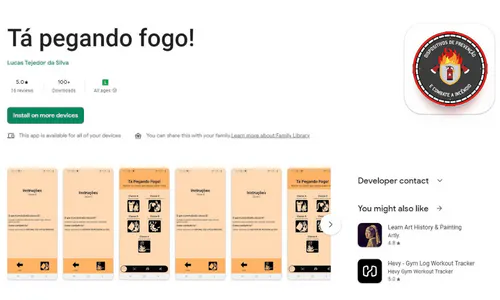
While the proposal to integrate AI for automated fire detection was interesting, it also exposed certain limitations in my expertise, specifically in the area of image analysis through AI. Recognizing this gap, we decided to, momentarily, pursue another idea: the creation of the "Tá Pegando Fogo" (It’s Catching Fire) app.
The app was designed to serve as an on-the-go reference for students, enabling them to classify fires and understand the appropriate extinguishers to use in case of an emergency. The need for such a resource cannot be overstated, as using the wrong type of extinguisher—like a water extinguisher on an electrical (Class C) fire—could have deadly consequences.
The app was met with resounding success. Currently, it continues to be used in the training sessions and has received over 100 installations from Google Play Store, backed by primarily positive reviews and excellent performance metrics.
Throught 2020, while developing the app, I continued to work on my knowledge about A.I. which later culminated in the presentation of my First article explaining common machine learning algorithms in the Federal Center of Technology (CEFET/RJ) scientific fair. See the article (It is my first one, remember this! :D) Click here to see it
Armed with enhanced skills and a significantly fortified knowledge base, the decision was made to proceed with the AI-driven fire safety model. As the exploration of AI in the context of fire safety continued - another gap in my expertise appeared, I still did not know how neural networks worked. (Just to clarify, neural networks constitute a subset of machine learning. My studies primarily focused on various machine learning algorithms, including but not limited to Linear Regression, K-Nearest Neighbors, and Support Vector Machines.) Thus, I start studying the realm of dense neural networks, focusing on various architectures and models. After rigorous testing and optimization, a specific architecture, "XCeption" emerged as the most effective. This architecture demonstrated over 85% accuracy per image in detecting fires.
Given the project's ultimate goal of real-time fire detection through video feeds, this level of accuracy was particularly promising. Multiple frames in a video sequence would offer the opportunity for even higher aggregated accuracy, making the system robust against false positives by examining a sequence of images over time.
The success did not go unnoticed. The findings were published in the Brazilian Congress of Telecommunications (SBrT), bringing national visibility to the project and inviting scientific scrutiny that further honed the neural network’s performance. This milestone was significant not just as an academic achievement but also as a validation of the project’s scientific rigor.
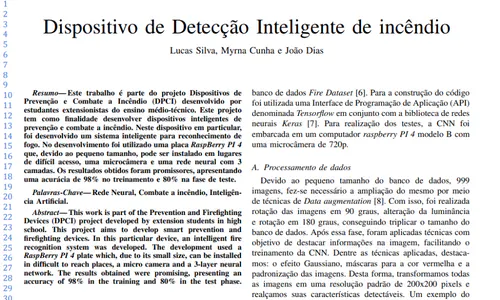
Despite the accomplishments, the journey wasn't without its challenges. The process of fine-tuning the model was iterative and benefited from ongoing scientific critique. In fact, exposure at conferences such as the Brazilian Symposium of Telecommunications (SBrT) provided valuable feedback that was instrumental in improving the neural network's performance.
Armed with these advancements, and others, we actively participated in scientific fairs, such as the Technology Fair at the Centro Federal de Tecnologia Celso Suckow da Fonseca, to showcase the project's potential and gain further insights. Presenting in multiple forums also opened doors for future collaborations and set the stage for real-world applications. The complete list of the awards can be seem in the table below. Also, a video submitted to the brazilian fair of young scientists is also avaiable for you to know the project in more depht.
Awards List
I only listed the awards won when I was a member of the project.
Achievements | Place | Certificate |
|---|---|---|
1st Place | Cefet/RJ Technology Fair (EXPOTEC) - 2020 | |
3rd Place | Science, Technology and Innovation Fair of the State of Rio de Janeiro - 2020 | |
2nd Place | Cefet/RJ Technology Fair (EXPOTEC) - 2021 | |
1st Place | Science, Technology and Innovation Fair of the State of Rio de Janeiro (FECTI) - 2021 | |
Published Article | Brazilian Symposium of Telecommunications - 2021 | |
2nd Place | Brazilian Fair of Young Scientists (FBJC) - 2022 | |
2nd Place | Science, Technology and Innovation Fair of the State of Rio de Janeiro (FECTI) - 2022 | |
1st Place | Cefet/RJ Technology Fair (EXPOTEC) - 2022 |