
Published work
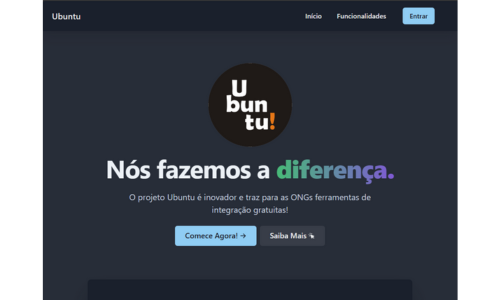
Have you ever considered the tremendous impact that could result from nonprofit organizations sharing resources and expertise? Enter the Ubuntu Project, a visionary platform aimed at achieving just that. In this article, I’ll dive deep into the intricacies of this project, from its inception to its features and accolades.
History of the project
The genesis of the Ubuntu Project dates back to 2021 and is credited to Professor Andréia. Observing the unmet needs within the NGO community, she felt the urgency for an application that could serve as a bridge between these organizations. Through a connection made by Professor Aline—who was familiar with my previous work on an app called "Recicla Aqui"—I was brought on board. It was then that I met Lairton, the former president of an NGO called "Casa de Caretas." We hit it off immediately and started working collaboratively to find solutions for the challenges NGOs face. My involvement included several visits to the NGO, multiple meetings, prototype presentations, and an iterative development process that helped refine the project.
After extensive development, we finally took the project live, launching both a website and a mobile application. Although the project's progress has somewhat plateaued due to my academic commitments, including university entrance exams and US applications, the initial feedback has been extraordinarily positive. NGOs that tested our prototype loved it and are eagerly waiting for its full operational capacity. Despite these hiccups, I am fully committed to resuming development and pushing the project forward, perhaps even transitioning it to another passionate individual to carry on the work.
Features
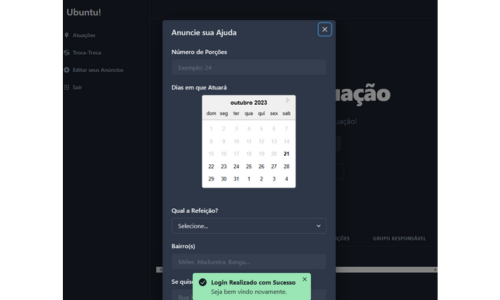
What can NGOs accomplish with Ubuntu? A lot! Let's take a hypothetical scenario where an NGO receives a donation of 500 plates of food. If it's a small organization with limited staff, logistical nightmares can ensue. The platform allows such NGOs to list their surplus resources, making it available for other NGOs in the network to assist with distribution. This creates a robust support network, increasing each NGO’s operational capabilities. Additionally, Ubuntu serves as a coordination center for various operations. For instance, if an NGO is planning a coat drive in the Santa Cruz area, another NGO can view this information on Ubuntu and choose to conduct their drive in a different location, like Madureira, to prevent overlap and increase the collective impact.
Accolades and Future Goals
The project has not gone unnoticed. It received a grant from the Federal Center of Technology and made it as one of the top 10 projects recognized by the Prudential Spirit of Community Awards. My own role in the project even led me to become a finalist in this prestigious award.
The Ubuntu Project, still in its nascent stages, has already shown the enormous impact it can have by fostering a cooperative network among NGOs. With its practical functionalities and early accolades, it’s poised to revolutionize how nonprofit organizations operate. My journey with Ubuntu is far from over, and I can’t wait to bring you more updates on this game-changing initiative.